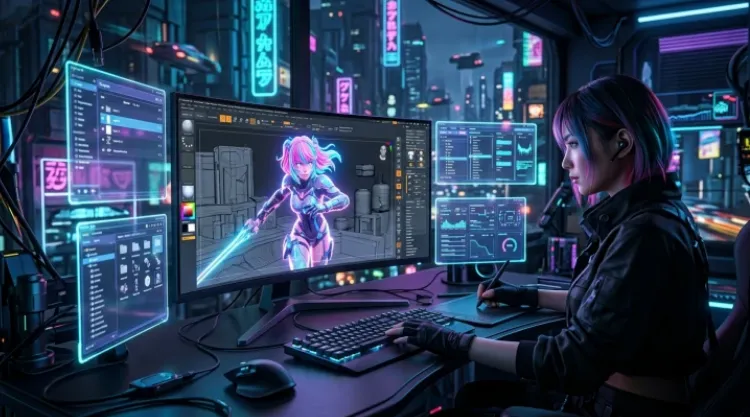
The gaming and entertainment industries are experiencing a profound technological shift in how digital characters are conceptualized and built. Creating highly detailed character models used to demand extensive manual labor from specialized technical artists. This traditional pipeline created significant production bottlenecks for studios aiming to produce expansive digital worlds or release content on tight schedules. The introduction of artificial intelligence into the creative workflow has fundamentally altered this dynamic. Today, developers and artists leverage powerful generative platforms to accelerate the transition from concept art to fully rigged, production-ready assets. Leading this transformation is Neural4D, a sophisticated generation platform that bridges the gap between static two-dimensional illustrations and dynamic spatial environments.
Developed through a collaborative academic initiative involving Nanjing University, DreamTech, Oxford University, and Fudan University, Neural4D utilizes advanced Spatial Sparse Attention mechanisms to interpret visual data with high precision. This technology is particularly transformative for stylized designs. For instance, developers looking to build your perfect anime character can generate high-fidelity 2D concept art directly within the platform. More importantly, N4D features a seamless closed-loop pipeline where these generated 2D images can be instantly processed by its Image-to-3D engine, reconstructing them into accurate spatial models with optimized topology.
Bridging the Gap Between Concept Art and Spatial Modeling
Character design traditionally operates in two distinct phases: conceptualization and execution. A concept artist first creates a series of 2D illustrations exploring various stylistic directions, outfits, and color palettes. Once a specific design is approved, a 3D modeler must painstakingly recreate that vision in a spatial environment, carefully sculpting the geometry and painting the textures to match the original two-dimensional reference. This manual translation process is notoriously prone to interpretation errors and delays, often requiring multiple revision cycles to ensure the final model accurately reflects the initial artistic intent.
By integrating generative algorithms directly into the production pipeline, modern platforms effectively merge these two distinct phases. An artist can rapidly iterate through dozens of visual concepts using advanced image generation capabilities. Once the ideal aesthetic is achieved, the underlying neural network can extrapolate the depth, volume, and material properties required to construct a comprehensive structural mesh.
- Rapid Conceptual Iteration: Design teams can experiment with drastically different character archetypes in a fraction of the time it previously took to produce a single set of concept sketches.
- Direct Spatial Translation: By utilizing advanced inference engines, the transition from a flat illustration to a dimensional object occurs without the need for manual vertex manipulation, preserving the exact stylistic nuances of the original design.
- Optimized Asset Production: The resulting geometry adheres to strict industry standards, ensuring the models are lightweight and performant across various game engines and interactive platforms.
Enhancing the Independent Development Ecosystem
While massive corporate studios benefit from the scalability of automated generation pipelines, the impact on independent developers and smaller creative teams is arguably more significant. Historically, independent creators faced a steep barrier to entry when attempting to produce visually complex interactive experiences, often turning to tech troubleshooting guides to keep their production setup running smoothly. The cost of hiring dedicated character modelers or purchasing premium pre-made assets often exceeded the budgets of small-scale projects.
Generative technologies democratize access to high-quality character production. A single independent designer can now conceptualize a unique protagonist, generate the required visual references, and reconstruct the character into a usable interactive asset entirely on their own. This newfound capability empowers a broader range of creators to tell visually ambitious stories and build expansive virtual environments that were previously impossible for small teams to execute.
Collaborative Asset Sharing and Iteration
The democratization of character creation has also fostered a vibrant global community of creators who actively share resources and technical knowledge. As developers produce new models and refine generative techniques, they frequently distribute their findings and base assets to assist others in the community.
For creators working on physical manifestations of their digital characters, such as custom tabletop miniatures or collectible figurines, finding structurally sound starting points is essential. Platforms like the DIY3D free print-ready files repository serve as vital hubs for this collaborative ecosystem. Here, designers can access verified, optimized geometry that bridges the digital and physical realms. This interconnected network of shared resources accelerates technical discovery and allows the entire community to iterate on character designs more efficiently.
The Technical Mechanics of Stylized Reconstruction
Reconstructing stylized artwork, such as anime-inspired characters, presents a unique set of technical challenges compared to photogrammetry or realistic object scanning. Stylized art intentionally breaks the rules of real-world physics, utilizing exaggerated proportions, flattened textures, and non-physical shading techniques to achieve a specific aesthetic.
Traditional reconstruction algorithms often struggle with these non-photorealistic inputs, attempting to apply realistic lighting models to textures that are meant to appear flat or cel-shaded. Advanced platforms have resolved this issue by training specialized neural networks exclusively on stylized datasets. These highly tuned inference engines understand the specific geometric logic behind anime proportions and can accurately predict the unseen angles of a character based on a single two-dimensional reference image.
- Intelligent Texture Mapping: The algorithm automatically projects the flat color palettes of the concept art onto the generated geometry, preserving the crisp lines and vibrant colors characteristic of stylized illustration.
- Proportional Inference: The system correctly interprets the exaggerated features of stylized characters, such as enlarged eyes or simplified facial structures, ensuring the resulting geometry matches the artistic intent without appearing distorted in three dimensions.
- Rigging and Animation Preparation: Beyond static geometry, modern pipelines can also infer the necessary joint placements for skeletal rigging, drastically reducing the time required to prepare the character for complex animations.
The integration of automated 3D reconstruction into character design workflows represents a critical milestone in digital entertainment production. By effectively eliminating the technical bottleneck between two-dimensional conceptualization and spatial execution, developers can focus their resources entirely on storytelling, gameplay mechanics, and creative direction. The ability to rapidly generate, refine, and deploy highly detailed character assets is no longer a futuristic concept; it is an accessible operational standard that will define the next generation of interactive media.
