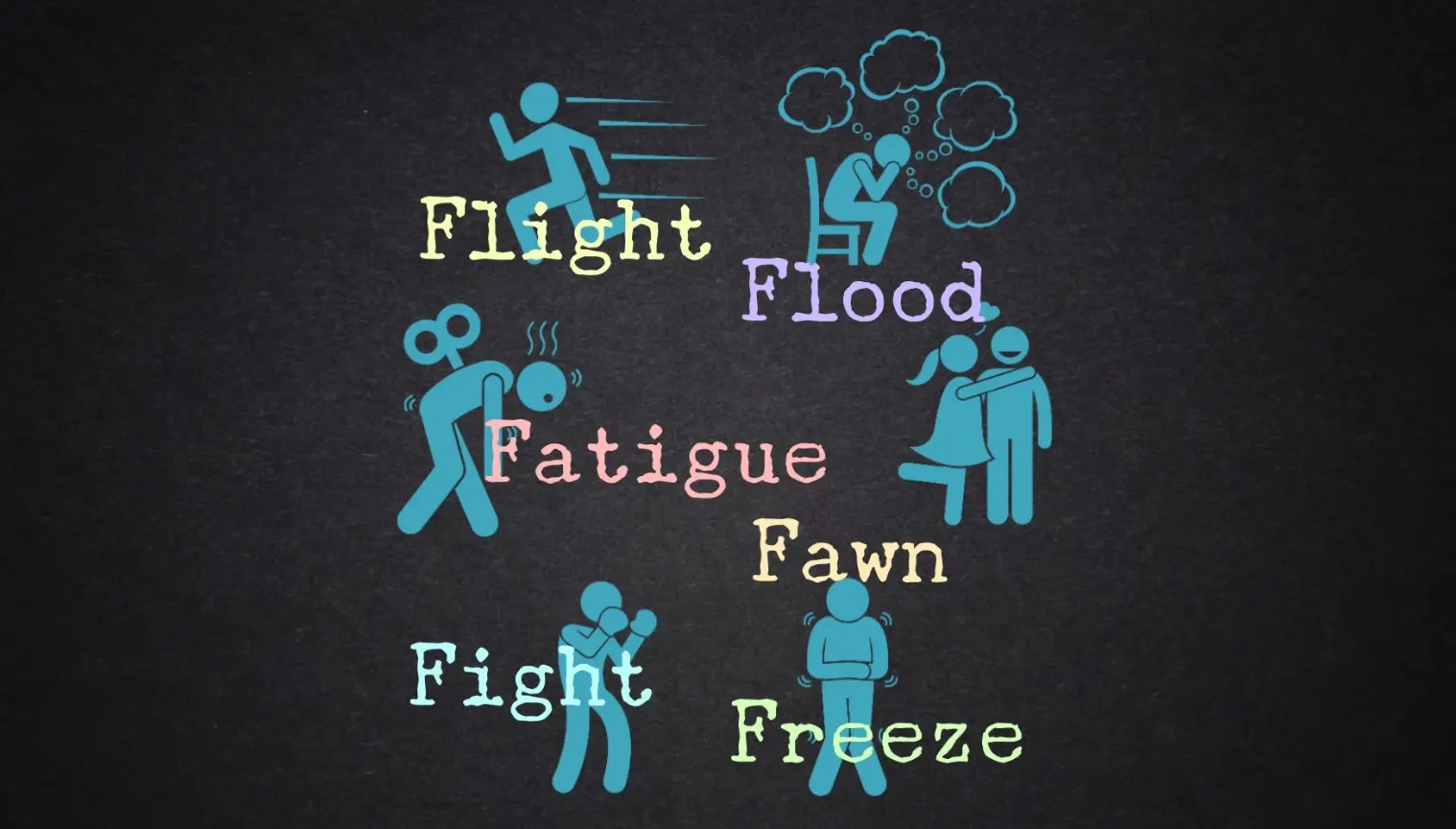
Every person has a system that is meant to keep them safe from harm. When there is danger, the body responds immediately, most often without any conscious thought. This ancient survival mechanism is termed as the fight flight freeze fawn response. While this was useful for our ancestors in physically dangerous situations, its impact in the modern world—especially for trauma survivors—can be very deep and lasting.
Knowing how these responses manifest in your daily life gives you the tools to untangle the web of fear, stress, and overwhelm. It’s not only about understanding the reason behind the panic or shutdown but also understanding how your body is trying to help you and keep you safe in an attempt to protect you, even when there is no threat around.
The Evolutionary Purpose of Survival Responses
The central part of the fight-flight-freeze fawn responses concerns automatic defense mechanisms, which are activated by the amygdala region in the brain. The moment we encounter “danger,” which could be anything from a charging animal to a raised voice, our brain triggers an alarm and releases stress hormones to prepare us for action. This cascade of physiological changes enables us to combat a threat, run away from it, shut down, or appease it.
In the past, these reactions were essential for surviving dangerous environments or predators. In modern society, threats are often more emotionally based than physically, such as disapproval, rejection, financial troubles, or relationship conflict. The body’s nervous system treats a toxic relationship with the same instinctual response it would have for a tiger.
When the System Gets Stuck
The issue does not lie with the survival response. Trauma or chronic stress, however, can train the body to remain perpetually on high alert. Many trauma victims have a habit of grossly underestimating the magnitude of a minor stimulus and react to it as though there’s an existential threat posed to them and their life is in danger. Such reactions can become hardwired, so deeply rooted that one interprets it as part of their character.
This can result in disrupted relationships, burnout, self-destructive behaviors, and even physical ailments like migraines or gastrointestinal disorders. The mind may not fully grasp the situation, but the body always hears what it goes through.
How Each Response Manifests in Real Life
Consider how each survival response impacts various aspects of life.
The fight can express itself through defensiveness, arguing, dominating, or engaging in emotional outbursts. These are attempts by the body to restore control over what is perceived as an unsafe environment.
Flight manifests itself as attempting to avoid something, such as having a difficult conversation, shifting from one job to another, or immersing oneself in work or activities to sidestep discomfort.
Freeze can result in feeling stuck, procrastination, chronic fatigue, or dissociation. The mind decides to switch off because being present is perilous.
Fawn results in people-pleasing, lack of boundaries, or conflict avoidance by suppressing personal needs.
These are all learned responses. Eventually, they become coping strategies the nervous system employs in an attempt to not re-experience suffering or abandonment.
The Relationship Between Trauma and the Nervous System
Below what is said, one of the key concepts to know is that these responses are all biological—not weaknesses of character or behavior. During upbringing in an environment where feelings were unsafe, love was contingent, or boundaries were frequently violated, the individual’s nervous system fundamentally adapts.
Such adaptations can manifest as emotional numbness, unconditional compliance, or agreement to everything. The body remembers what it takes to be safe, and those responses tend to follow us into adulthood—even when we are no longer in peril.
Overactivation of the body’s stress response results in an imbalance in the autonomic nervous system. This can disrupt mental health, as seen in anxiety, PTSD, depression, or alcohol and drug-related disorders. For many people, it takes years or even decades to realize that their life experiences, which they viewed as failures, in fact, were the outcome of trauma.
Self-awareness is the First Step to Healing
Healing starts with awareness. Identifying what survival response is active in a moment provides useful tools. It shifts the narrative internally from “What’s wrong with me?” to “Oh, this is my body trying to protect me.”
Awareness creates a pause that helps question whether there is a reaction rooted in the present or a response from the past. This shift fosters the possibility of real healing.
With the help of journaling, therapy, mindfulness, and education of the nervous system, awareness can be deepened. The more you understand your survival response, the more compassion you can bring toward it. That compassion will help initiate the change that needs to take place.
The Healing Power of Connection
Disconnection occurs when someone encounters trauma, neglect, and even abandonment. Hence, it is unarguable that healing happens through connection. Therapy, mentoring friendships, safe romantic partnerships, and trauma-informed support groups are all good examples of where healing can take place.
Healthy relationships assist with nervous system regulation. When someone responds to your shutdown with patience or your panic with empathy, your body learns that it no longer needs to be vigilant. Your brain learns over time that vulnerability and intimacy can exist without peril.
The connection provides opportunities to heal. When you learn to speak your truth, set boundaries, or ask without being punished, you start rewriting the nervous system’s script that it has been attached to.
Building New Patterns and Coping Skills
The best part is that the brain is not fixed. Through self-regulation, self-awareness, and healthy responses, new patterns can be created due to neuroplasticity. Even though trauma does not magically vanish, the ability to stop being controlled by reflexive responses becomes a possibility.
This may look like noticing when you are fawning and reminding yourself that your needs matter, too. Or noticing a flight response in the middle of a conflict and deciding to remain engaged, even if just for a moment longer.
Breathwork, somatic therapy, emotional release techniques, and grounding exercises restore safety to the body and improve resilience. Over time, the fight flight freeze fawn system calms down and no longer reacts to every trigger or reminder of past pain.
Childhood Trauma and the Fawn Response
The fawn response needs special focus because it is one of the most misunderstood. Being nice or agreeable is often thought to be a part of one’s personality. However, for those who live in unsafe homes, fawning often becomes a necessary survival instinct.
This can include excessive apologizing, anticipating others’ needs while neglecting one’s own, or fearing disapproval so much that one risks losing their identity. The fawn response centers around safety through submission. Healing requires relearning how to listen to one’s inner voice without guilt or shame.
As with any trauma response, the goal is not to eradicate the instinct. In some cases, it is still beneficial. With development, you gain insight into when to utilize it—and when to take a different approach.
Creating Safety From Within
Healing from trauma is ultimately constructing a life where your nervous system does not perceive the world as dangerous (by default). This doesn’t mean ignoring pain or pretending everything’s okay. This means forging new experiences that contradict the previous ones.
Your body learns safety can exist—and also be repeatable—when you hold boundaries and are not abandoned when you express emotion and aren’t punished.
The fight-flight-freeze fawn system was developed to ensure your survival. Now, it’s time to learn how to truly live.
Final Thoughts
Understanding trauma responses is not only informative; it is life-changing. It reframes the discussion from blame to biology and from shame to self-respect. Awareness of the fight-flight-freeze fawn patterns allows you to shift gently from survival to sovereignty, one decision at a time.
At the Mental Health Center of San Diego, we focus on trauma-informed strategies that assist clients in recognizing, understanding, and healing from survival-based patterns. Our caring approach assists you in creating safety, rebuilding trust in your body, and reclaiming life from fear.
